
Championship Sport Status Hub
STUNT has received approval as an NCAA emerging sport for Division I, II, and III! An emerging sport is a women’s sport recognized by the NCAA that is intended to help schools provide more athletics opportunities for women and more sport-sponsorship options for the institutions, and also help that sport achieve NCAA Championship Status. This page will help provide resources and updates on the progress of our journey!
See the NCAA STUNT One Pager Championship Status Media Guide
STUNT and Emerging Sport Timeline
Read the CWA April Committee Report
Read the press release from USA Cheer
Read the recommendation letter from the Committee on Women’s Athletics
From the NCAA Media Center:
…STUNT has received a recommendation from the Committee on Women’s Athletics to join the program.
…STUNT recently received a recommendation to be added to the program. Committee members were pleased that the sport has seen a steady increase in the number of NCAA member sponsorships, is relatively inexpensive to sponsor and provides participation opportunities for female student-athletes of all body types and from diverse sports backgrounds. Currently, nearly 20 NCAA schools sponsor varsity STUNT.
The Divisions II and III Management Councils will meet July 20-21 to consider the recommendation to add STUNT to the program. After reviewing the recommendation, each council will decide whether to sponsor a legislative proposal. If a council decides to sponsor a proposal to add STUNT, the membership of that division would vote at the 2021 NCAA Convention in January on whether to add the sport. The Division I Strategic Vision and Planning Committee did not recommend introducing STUNT as an emerging sport at this time due to budget constraints stemming from the COVID-19 pandemic. The committee can revisit discussions in the future.
STUNT submitted our 200 page application to the NCAA’s Committee on Women’s Athletics to be considered as an emerging sport! This application was the culmination of 10 years of hard work and commitment from administrators, coaches, and athletes across the country.
At the time of the application, STUNT had 25 NCAA schools participating, including 12 as varsity programs.
In the 2022 season, 42 NCAA schools will be playing STUNT, including 20 as varsity programs, with 7 more NCAA varsity programs committed to the 2023 season!

March 29, 2013 – Bixby High School, Broken Arrow High School, Bristow High School, and Tahlequah High School became the first high school teams to play STUNT at Bixby High School in Oklahoma.
Louisville, KY was the site of the first STUNT tournament on January 29, 2011. The tournament featured the University of Louisville, Morehead State University, and West Virginia University.
Twenty college programs stepped onto the STUNT mats in Season One!
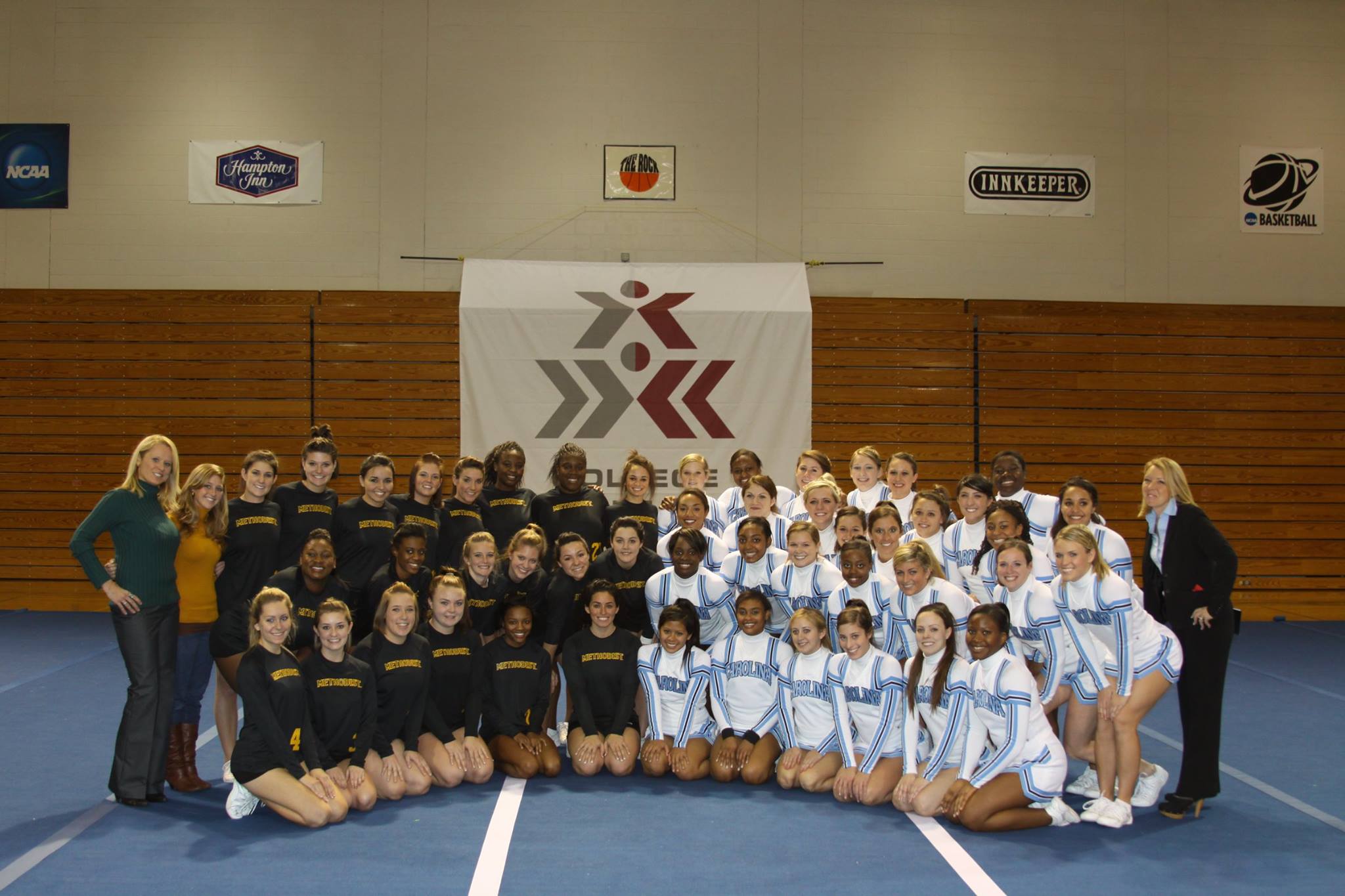
Approximately 30 coaches gathered at Methodist University in Fayetteville, NC to learn about STUNT and witness the first STUNT scrimmage game, held between Methodist University and the University of North Carolina.
USA Cheer was founded in 2007 with the mission of promoting cheerleading safety, fielding a national team for international competition, and increasing participation in cheerleading throughout the United States.
Champion & Emerging Sport Questions and Answers
At the 2026 NCAA Convention, all three divisions voted to approve stunt becoming an NCAA championship sport, with its first NCAA championship projected for spring 2027.
Stunt’s growth has been rapid across the NCAA, crossing the benchmark of 40 schools meeting minimum contest and participant requirements in its first year as an emerging sport in all three divisions. It joined the Emerging Sports for Women program in 2023 in Divisions I and II, while Division III added it in 2024.
An emerging sport is a women’s sport recognized by the NCAA that is intended to help schools provide more athletics opportunities for women and more sport-sponsorship options for the institutions, and also help that sport achieve NCAA championship status.
An emerging sport for women is a sport that:
- Meets the definition of a sport.
- Is accepted and recognized by the NCAA (as approved by its divisional governance processes) as an emerging sport for women.
- Provides additional athletics opportunities to female student-athletes and demonstrates the NCAA’s commitment to gender equity among student-athletes.
Varsity STUNT programs should be in contact with their institution’s compliance director to ensure they are up to date with and following all NCAA regulations.
From the perspective of scholastic sports, a club sport is usually sponsored and led by students, with the student members making decisions regarding hiring, budget, travel, etc. Unlike intramural sports, club sports travel and play other university programs.
A varsity sport is funded under the athletics department, where the athletics department makes the hiring, budget, and travel decisions. Like other varsity sports, varsity STUNT programs have recruiting budgets and scholarships available based on their university’s criteria. Varsity programs can begin directly as a varsity program under athletics, or they may transition from a club sport to a varsity sport.
STUNT welcomes club and varsity programs!
The CWA’s endorsement of STUNT and the Division Management Council’s sponsorships of STUNT are a victory for Title IX and female athletes everywhere. Institutions can already count STUNT towards their Title IX requirements and help grow participation opportunities for female student athletes. However, the continued recognition of the competitive athletic nature of STUNT and the movement forward in the emerging sport process helps institutions commit to increased female athletic participation.
STUNT and Competitive Cheerleading are two different disciplines of “cheer” that both utilize technical skills in their sport, but there are differences. STUNT is the discipline that has been recommended by the CWA for Emerging Sport status.
| STUNT | Competitive Cheer | |
|---|---|---|
| Event | 45 -60 minute game | 2:30 minute routine |
| Two teams in head-to-head competition. | Single teams perform one at a time at an event with many teams in the same competition division. | |
| Scoring | Objective – Based on execution | Subjective/Objective – Based on routine choreography and execution |
| Format | 4 Quarter Format Based on Skills – Quarters consist of Partner Stunts, Pyramids and Tosses, Jumps and Tumbling. Routines are all compulsory. | Based on individual routine choreography. Includes crowd-leading, and dance elements as well as stunting, pyramids, tumbling, and jumps. |
| Season | Teams compete as an exclusively Spring sport. | Teams compete year-round. |
For more information, see the USA Cheer Position Paper on Title IX
The safety and well-being of the STUNT athlete is of primary importance, and is the first guiding principle of each STUNT committee.
STUNT involves athletes participating in partner stunts, pyramids, tosses, jumps, and tumbling. These skills include height, inversion, and rotation of the body as well as working in coordination with other athletes to perform these skills. Special care should be taken by supervisory staff ensure that skills are taught in a progressive manner, requiring proficiency before advancing to skills with higher difficulty.
The STUNT format, scoring system, and coaches’ education work together to promotes athlete safety and risk management.
For more information, be sure to fill out the interest form and follow the step-by-step “How to Start a STUNT Team.” For high school or club/youth rec teams, look for the “How to Start a STUNT Team” under your menu tab in the main menu.
Other Important Links
If you want to compete in NCAA sports, you need to register with the NCAA Eligibility Center. Plan to register before starting your freshman year of high school (or year nine of secondary school). The information here will help guide you through the registration process.
NCAA member schools have adopted rules to create an equitable recruiting environment that promotes student-athlete well-being. The rules define who may be involved in the recruiting process, when recruiting may occur and the conditions under which recruiting may be conducted.
This guide answers important questions for four groups of people involved in the NCAA initial-eligibility process: 1) High school students who hope to compete in college sports at an NCAA school, 2) Parents, guardians and family members of high school students, 3) High school counselors and athletics administrators, and 4) High school and non-scholastic coaches.
The decision to transfer to another school is an important and often difficult one in your college career. Before you act, do your homework. Make sure you understand how transferring will affect you, so you don’t negatively impact your education or your chances to play college sports.